A scandalous story
A respected man
My 3rd great-grandfather, Josiah Nelson Starin, was born in Guilderland, near Albany, New York, on December 9, 1810. He and his wife, Andelucia Henry, raised their family in Auburn, in Cayuga County. Their daughter Georgianna married Charles Trumbull White, and Georgianna and Charles were the parents of my great-grandfather, Gaylord Starin White.
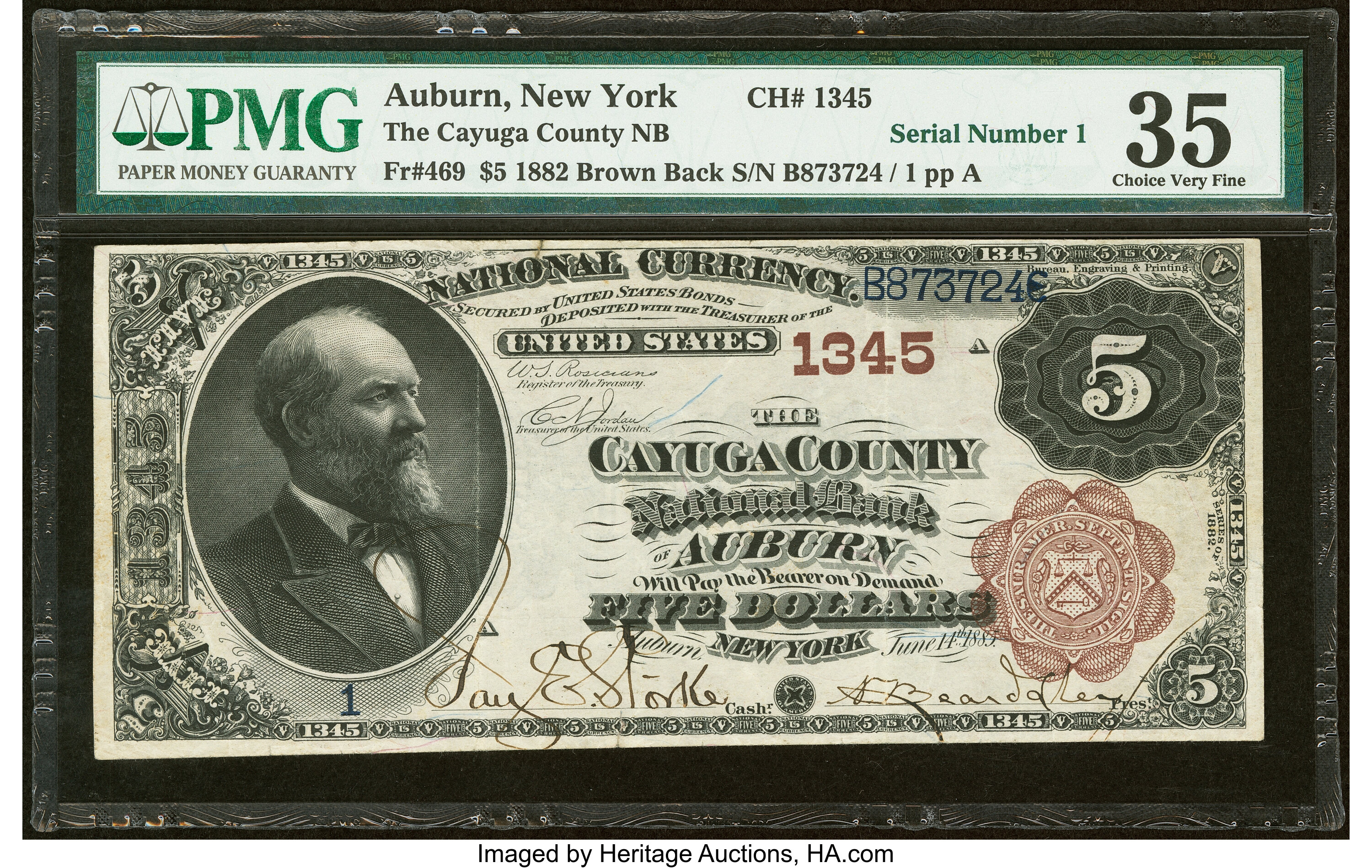
Josiah joined the Cayuga County Bank as its teller in 1835, soon after it opened, and was made cashier on January 15, 1841.[3][4] Nelson Beardsley became the bank's president in 1843.[4] It was the oldest and most important bank in Auburn, and in that era the cashier was the man who actually ran it day to day. He kept the books, held the keys to the vault, and looked after the securities in the bank's care. Josiah held that post until June 1873—more than thirty-two years. He enjoyed the confidence and respect of both the bank and the community, and he was a co-partner in several businesses, including the Empire [clothes] Wringer Company and the Auburn Tool Company.[2] He was also an elder of Auburn's Second Presbyterian Church.[1]
Henry Hall's History of Auburn, published in 1869, lists Josiah among the active members of the Auburn Literary Association, founded in 1838, whose roll soon included nearly all of the town's prominent citizens. On May 15, 1851, Josiah was also one of the eight men who met to organize the Fort Hill Cemetery Association.[4] Fort Hill Cemetery later became the resting place of William H. Seward, Lincoln's Secretary of State, and Harriet Tubman.
Mr. Gould's bonds
In 1865, the bank gave up its state charter and became the Cayuga County National Bank. National banks could issue their own paper money, but first they had to deposit U.S. government bonds with the Comptroller of the Currency in Washington as security. Like many banks, Cayuga County didn't own enough bonds, so it borrowed them. One lender was Benjamin Gould of Aurora, a man the Herald describes as formerly well known in New York state politics. In June 1865 he lent the bank $93,000 in government bonds (roughly $2.5 million in 2026 money), and Nelson Beardsley personally guaranteed the loan as the bank's surety.[1][5]
In time the bank bought bonds of its own and offered Gould his back. Gould wanted to keep his money in bonds but didn't want to be responsible for that much paper himself, so he asked the bank to hold them for him as a "special deposit." They went into the bank vault, and became Josiah's personal responsibility. Every six months, following Gould's instructions, Josiah clipped the interest coupons from the bonds, cashed them, and credited the money to Gould's account.
A son-in-law in trouble
Around 1870, Josiah's son-in-law, Israel J. Gray, husband of his eldest daughter, Mary Jane Starin, was found to be a defaulter as cashier of the Whitestown Bank, near Utica. Josiah tried to save him. He spent his own money first. Then, as the Herald put it, he made his "first trespass" on the property of others entrusted to him: he sent some of Gould's bonds to New York, where they were converted to cash for Gray's benefit.
Having taken some of the bonds, Josiah found it easy to take the rest. Hoping to win back what was already lost, he used them to speculate in stocks, and the whole amount was lost. The Herald notes that Josiah had a son and a son-in-law who were brokers in New York. The son was Henry Gaylord Starin, and the son-in-law was probably my 2nd great-grandfather, Charles Trumbull White. The Cayuga County Bank's officers knew Josiah traded in stocks and even handled some brokerage business for clients, but they trusted him so completely that they never looked into it.
All the while, Josiah kept paying Gould his interest on the bank's behalf, so nothing seemed amiss. Court records show that Beardsley once asked his cashier whether the interest on Gould's bonds "had been kept up," and Josiah assured him that it had.[5]
The defalcation is discovered
In December 1872, Gould was preparing for a long trip to Europe and wanted his affairs in order in case he didn't return. He sent his son-in-law, Dell Woodruff of Auburn, to the Cayuga County Bank with an order for his $93,000 in bonds. Josiah made what the Herald called "bungling excuses" and sent Woodruff away. Woodruff alerted Gould, who hurried to Auburn. Josiah was forced to admit that he had taken the bonds and could not replace them.
Gould was furious and threatened to take legal action against the bank. Nelson Beardsley, the bank's president, stepped in. He argued that the bank as a corporation wasn't responsible for a special deposit. It had offered Gould his bonds, and Gould had chosen to leave them with Josiah, so this was a matter between the two men. (In court, years later, the bank put it more bluntly: the bonds had been returned to Gould, and the bank owed him nothing.[5]) Beardsley also feared that a lawsuit would damage the bank's credit. So he helped arrange a private settlement.
According to the Herald, Josiah gave up about $30,000 in cash and securities (roughly $800,000 in 2026 money), which was his entire personal estate. The rest was guaranteed to Gould by friends of the bank, the most prominent being Beardsley himself and Edwin B. Morgan of Aurora, a director of the bank, former congressman, and first president of Wells Fargo & Company. Court records give a somewhat different picture. On March 12, 1873, Gould signed a release to the bank in return for $25,000, paid "by the defendant The Cayuga County National Bank, or by Josiah N. Starin," and Josiah also created a trust for Gould's benefit, apparently to cover at least part of the balance.[5] With the matter settled, Gould left for Europe.
The scandal goes public
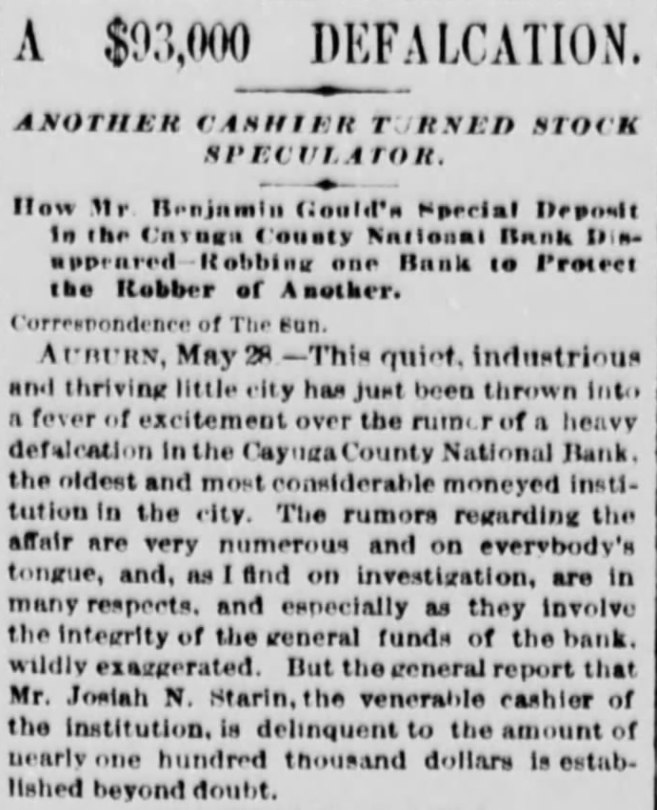
For about five months the affair stayed quiet. Then rumors spread through Auburn, and on May 30, 1873, the New York Herald published a story under the headline "A $93,000 Defalcation." Its correspondent reported that Josiah was still the bank's cashier, though his work was being watched closely by the president.
The reporter called on Beardsley at his home. Beardsley refused to make an official statement but insisted the bank itself had lost nothing and that its depositors were safe. He said that a national bank examiner had recently gone over the bank's books at his request and found them satisfactory, and that he would pledge his own large personal fortune to the bank's creditors if necessary. Asked why Josiah was still cashier, Beardsley said only that there were reasons he wasn't at liberty to give.
Josiah didn't stay long. On June 10, 1873, less than two weeks after the Herald story, he resigned. Alanson L. Palmer was made acting cashier, and on October 6 he became cashier.[3] Twelve years later, in a history of the bank delivered to the Cayuga County Historical Society, D. W. Adams wrote that Josiah's resignation "calls up memories on which I do not propose to dwell."[3]
That September, the Panic of 1873 swept the world's financial markets and caused a depression in North America from 1873 to 1877. On October 1, on Edwin Morgan's motion, the bank's directors decided not to pay a dividend in November, "owing to the present financial condition of the country." In 1874 they reduced the bank's capital from $250,000 to $200,000, which, Adams wrote, indicated that "the bank had sustained losses." Adams blamed the perils of the times rather than Josiah.[3] Still, it sits uneasily with Beardsley's assurance to the Herald that the bank was unaffected.
Gould goes to court
The settlement did not end the matter. Gould came to believe he had been cheated, and around 1876 or 1877 he sued both the bank and Nelson Beardsley, as the loan's surety, for the full value of his bonds. He hired George F. Comstock, a former chief judge of New York's highest court, to argue his case.[5]
The trial court found that the bonds had never been returned or replaced, and that Gould had been induced to accept the 1873 compromise "by the fraud of the defendants." Even so, Gould lost. The law required anyone seeking to undo an agreement on the grounds of fraud to first give back whatever he had received under it, and Gould had kept the $25,000. Only at the close of the trial did he deposit $35,159.72 (the $25,000 plus interest) with the court, and even then only on conditions. That came too late. His claim against Beardsley failed for a different reason: more than ten years had passed, and Beardsley's question to his cashier about the interest was not enough to keep the claim alive.[5]
A state appeals court affirmed the dismissal in June 1880, and on October 4, 1881, the New York Court of Appeals affirmed it again, unanimously. Judge Robert Earl's opinion pointed out that a different kind of lawsuit, an action in equity, could have unwound the compromise and brought in "the trust created by Starin for plaintiff's benefit," with "Starin and the trustee" made parties to the case.[5] Gould had simply brought the wrong kind of suit. The case had a long afterlife: in 1922 it was reprinted in a law-school casebook as a lesson in exactly that mistake.[6]
Afterward
Andelucia died in 1891. Josiah eventually settled in Philadelphia, and he died in Germantown, Philadelphia, on July 26, 1895, aged 84. Their son, Henry Gaylord Starin, and their daughter Mary Jane also died in Philadelphia. Israel Gray died in Utica in 1891.